
Studies of sequential euploid embryo transfers suggest that about 63–65% of patients have a live birth after one transfer, increasing to about 83% after two, 92–93% after three, 96% after four, and 98% after five.
This Evidence Guide is updated as important new evidence becomes available for this topic.
Changelog
- One euploid embryo resulted in a live birth in about 63–65% of first transfers in the largest sequential-transfer studies.
- The cumulative chance of at least one live birth rises to about 83–84% with two euploids and 92–93% with three.
- The “three euploid embryos per baby” rule means roughly a 9 in 10 chance of at least one live birth, not that everyone needs three.
- A failed euploid transfer doesn’t mean the next embryo has little chance of working. Live birth rates remained around 50–58% per transfer from the second through fifth attempts in the largest study.
- These are population estimates, not personalized predictions, and the later-transfer estimates are less certain.
New to PGT-A? Read my Comprehensive guide to PGT-A.
🔗 Original studies are referenced in this post or within the linked Remembryo posts.
💡 Reminder: Terms underlined with a dotted black line have glossary definitions. Hover or tap to see a short definition, or select “Read full definition” in the pop-up to view the complete glossary entry. Viewing glossary entries does not count toward your paywall limit.
How many euploid embryos do I need for one baby?
There isn’t one number that everyone needs. However, research suggests that the chance of at least one live birth rises from around 63–65% after one single euploid embryo transfer to more than 90% after up to three separate transfers and around 98% after up to five.
A euploid embryo is an embryo that PGT-A has classified as having the expected number of chromosomes.
The most useful measure here is the cumulative live birth rate: the chance of having at least one live birth after transferring a certain number of euploids one at a time, in separate transfers.
For example, the chance after two euploid embryos includes the first transfer of one embryo and, if that doesn’t result in a live birth, a later transfer of the second embryo. The chance after three includes up to three separate single-embryo transfers, and so on.
| Number of single euploid transfers | Estimated chance of ≥1 live birth |
|---|---|
| 1 | ~63–65% |
| 2 | ~83–84% |
| 3 | ~92–93% |
| 4 | ~96% |
| 5 | ~98% |
| 6 | ~99%* |
*The sixth-transfer estimate is especially uncertain.
These estimates are very consistent across several large studies:
- Pirtea et al. (2021) reported a 92.6% cumulative live birth rate after up to three euploid transfers.
- Gill et al. (2024) estimated a 98.1% cumulative live birth rate after five transfers.
- Durbin et al. (2026) estimated cumulative rates of 63.1%, 83.0%, 92.0%, 96.0%, 98.3%, and 98.8% after transfers one through six.

The evidence is strongest for the first few transfers, when many more patients were included. Two issues make the later numbers less certain:
- Fewer patients: Durbin et al. (2026) included 5,811 first transfers, but only 33 women had a fifth transfer and only 7 had a sixth transfer.
-
Treatment dropout: About one-third or more of patients stopped treatment after each unsuccessful transfer. Because so many patients dropped out, Durbin et al. (2026) had to account for what might have happened if they had continued:
- Estimated range: The cumulative chance after six transfers was 98.8% when patients who stopped were assumed to have similar future chances as those who continued, and 81.0% when they were assumed to never have a live birth.
- Who dropped out: Patients who stopped after the first three transfers tended to be older than those who continued, suggesting that those who continued may have had a better prognosis. The true rate may fall somewhere between the two estimates.
Three euploids have therefore been associated with about a 92–93% chance of at least one live birth, but no number of euploid embryos guarantees a baby.
Read more on Remembryo:
- Gill et al. (2024) — “True” recurrent implantation failure is rare after five consecutive euploid embryo transfers
Is the “three euploid embryos per baby” rule accurate?
It’s a useful rule of thumb, but it doesn’t mean that everyone needs three euploid embryos to have one baby.
A better way to think about it is:
Three euploid embryos ≈ a 92–93% chance of at least one live birth.
Pirtea et al. (2021) reported a cumulative live birth rate of 92.6% after up to three euploid transfers, while Durbin et al. (2026) estimated 92.0%.
Many patients won’t need all three. About 63–65% had a live birth after the first transfer in these studies, while two euploids were associated with about an 83–84% cumulative chance.
Importantly, this doesn’t mean that patients should have three euploid embryos before starting transfers. These estimates describe what happens when euploid embryos are transferred one at a time, with another embryo transferred if the previous one doesn’t result in a live birth.
This also doesn’t mean that every group of three euploid embryos provides exactly a 92–93% chance. These are population averages. An individual patient may have a live birth after their first transfer, may need several transfers, or may not have a live birth despite several attempts.
So whether three euploids is “enough” kind of depends on how much uncertainty someone is comfortable with. One person might consider an ~83% chance enough, while another person may prefer a higher chance with three or four euploids.
The rule also can’t simply be multiplied when planning for more children. For example, having six euploids doesn’t mean that someone has the same ~92–93% chance of having two children. These studies estimated the chance of at least one live birth, and it’s difficult to know how many embryos an individual patient will need until they begin transferring them.
Does each euploid embryo have the same chance of becoming a baby?
No. Euploid embryos can still have different chances of resulting in a live birth.
In both studies, the first embryo transferred had the highest live birth rate:
| Transfer | Pirtea et al. (2021) | Durbin et al. (2026) |
|---|---|---|
| 1st | 64.8% | 63.1% |
| 2nd | 54.4% | 54.0% |
| 3rd | 54.1% | 53.1% |
One possible explanation is embryo ranking. Clinics generally transfer the embryo considered most promising first, based on characteristics such as developmental day and embryo grade.
Developmental day appears to matter even after PGT-A. Firmin et al. (2026) found that for PGT-A-tested embryos:
- Day 5: 58.9% live birth rate
- Day 6: 45.3%
- Day 7: 23.4%
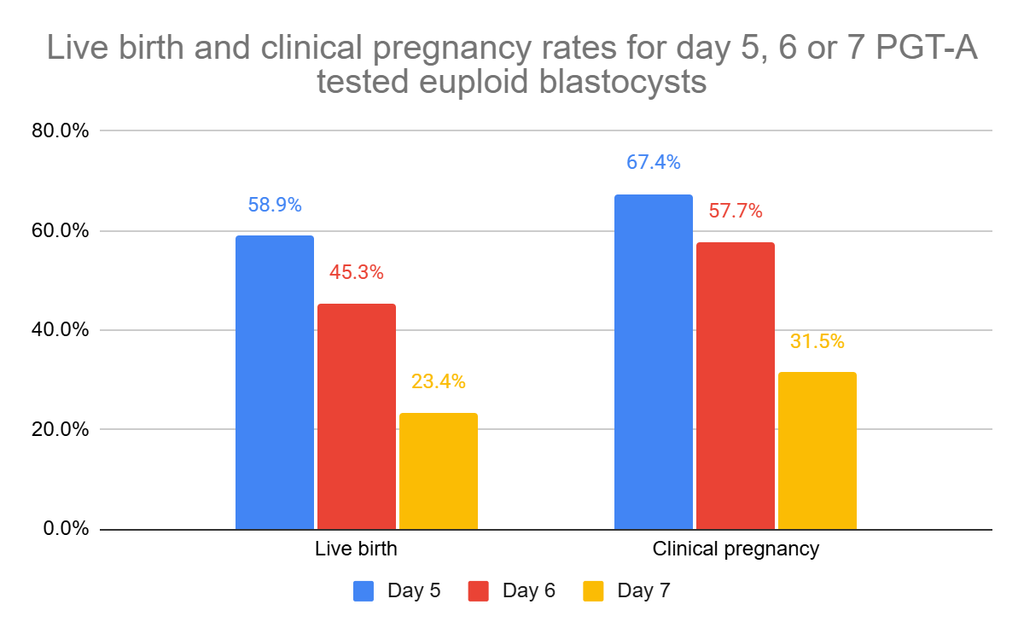
Durbin et al. (2026) also found lower live birth rates for day 7 euploids than day 5 or day 6 euploids during the first two transfers.
The embryo’s grade is also important. Zhao et al. (2018) compared outcomes for euploid embryos with different grades:
- Good quality (AA, AB or BA): about 50% live birth
- Average (AC, CA or BB): 42.3%
- Poor (BC or CB): 25.0%
PGT-A therefore doesn’t make all euploid embryos equivalent. Embryo day, grade, and other characteristics can still affect the chance of success.
Read more on Remembryo:
- Firmin et al. (2026) — Do day 7 blastocysts perform as well as day 5 or day 6?
Does a failed euploid transfer lower the chance that the next one will work?
A failed euploid transfer doesn’t mean that the next embryo has little chance of working.
The largest decline in live birth rates occurred between the first and second transfers, from around 63–65% to 54%. However, live birth rates then remained around 50–58% per transfer from the second through fifth attempts in Durbin et al. (2026).
One likely explanation for the higher success rate with the first transfer is embryo ranking. Clinics generally transfer the highest-ranked embryo first, leaving lower-ranked embryos for later transfers. So at least some of the decline may be related to the embryos remaining rather than the previous transfer having failed. However, it’s not clear whether embryo ranking fully explains the difference.
Patients in the Durbin et al. (2026) study also generally continued with their usual transfer protocols after an unsuccessful euploid transfer, without automatically adding new tests or treatments. Many patients still had success with later transfers. The authors argued that an early failed euploid transfer doesn’t necessarily mean that additional testing or treatment is needed before trying again.
Do age and other factors change how many euploid embryos I need?
They may, but current research can’t tell us exactly how many euploids an individual patient needs based on age, embryo characteristics, or other factors.
The numbers presented in this guide are population averages and individual chances of success can vary, depending on patient and embryo characteristics.
Age
As maternal age increases, patients are more likely to produce aneuploid eggs that can form aneuploid embryos. PGT-A can somewhat remove the impact of age related to embryo aneuploidy, but age could still affect the chance that a euploid embryo results in a live birth.
Reig et al. (2020) examined 8,175 single euploid transfers and found that live birth rates declined with increasing maternal age. After adjusting for embryo quality, developmental day, and other factors, the odds of live birth were still significantly lower beginning at ages 38–40 compared with patients younger than 35.
But the overall evidence is mixed. In a meta-analysis, Marti-Garcia et al. (2024) found that older patients had lower pregnancy and implantation rates and higher pregnancy-loss rates when studies using euploid embryos or donor eggs were combined. However, live birth wasn’t significantly different in the 10 studies reporting it.
Read more on Remembryo:
- Reig et al. (2020) — Euploid embryos show reduced implantation potential with advancing maternal age
- Marti-Garcia et al. (2024) — Meta-analysis examines impact of age on uterus and pregnancy outcomes after IVF
Embryo and patient characteristics
Other factors may also shift someone’s chance above or below the population average, including:
- embryo developmental day, as discussed above
- embryo grade, as discussed above
- previous transfer history;
- patient and uterine factors, such as endometrial thickness, fibroids or polyps, adenomyosis or endometriosis, immune factors, chronic endometritis, insulin resistance, and other conditions that may affect implantation.
Even when an embryo is euploid, implantation and live birth still depend on more than the embryo’s chromosome status. The uterine environment, maternal health, and the embryo transfer itself may all affect the chance of success. However, the evidence for many individual factors varies considerably, and it’s not currently possible to use them to reliably calculate how many euploid embryos a particular patient needs.
For example, lower per-transfer success with day 7 euploids doesn’t establish that someone with three day 7 euploids needs four instead.
For now, the ~63%, 83%, 92%, 96%, and 98% estimates are best viewed as population benchmarks. Your individual chance may be higher or lower.
Read more on Remembryo:
Euploid embryos aren’t the only embryos that can result in a baby
The estimates in this guide apply specifically to embryos classified as euploid by PGT-A. However, other embryos can also have reproductive potential. Depending on the circumstances, this may include some mosaic embryos, lower-grade blastocysts, and slower-developing embryos.
Clinic policies can also affect which embryos are available. For example, not all laboratories culture embryos through day 7 or biopsy lower-grade blastocysts, and clinics differ in which PGT-A results they will consider for transfer.
So the number of euploid embryos someone has isn’t necessarily the same as the number of embryos they have with the potential to result in a live birth.
What are the biggest gaps in the evidence?
Several important questions remain unanswered:
| What we don’t know | Why it matters |
|---|---|
| How patient, embryo, and clinic factors change the estimates | Age, embryo day and grade, patient characteristics, PGT-A testing, and clinic or laboratory practices may affect success, but we can’t reliably combine these factors into an individual cumulative live birth estimate. |
| How many euploids are needed for multiple children | The studies mainly estimate the chance of at least one live birth, so the results can’t simply be multiplied when planning for two or more children. |
| Whether to bank embryos before transferring | These studies don’t show whether it’s better to bank several euploids before starting transfers or begin transferring when one is available. |
| When additional testing or treatment may help | It’s unclear when additional testing or treatments should be considered after failed euploid transfers, or whether they improve the chance of success. |
| Whether the results apply equally across clinics | The main estimates come from a small number of fertility centers and may not apply equally to patients treated at other clinics. |
| The true chance after many transfers | Few patients reached transfers five or six, and there is very little evidence about what happens beyond six transfers. Many patients also stopped treatment before using all available embryos. |
The core studies were also retrospective, and patients able and willing to continue through many euploid transfers are a selected group. For example, patients who discontinued treatment in Durbin et al. (2026) tended to be older after the first several transfers. Other unmeasured differences between patients who continued and those who stopped could also affect the later-transfer estimates.
The evidence is therefore much better at answering “What happens on average?” than “Exactly what are my chances with the embryos I have?”
Continue Exploring — Members
🔒 Subscriber resources: How many euploids you need is only part of the question. Explore how many euploids you might obtain, how many eggs that may require, and other factors that could affect the embryos available to you.
- Two interactive calculators to explore how age, embryo grade, developmental day, and egg number relate to obtaining euploid embryos.
- Evidence for recurrent pregnancy loss and success with euploid embryo transfers.
- Making the most of your eggs and embryos to potentially increase the number of blastocysts, euploids, and transferable embryos available to you.
- Questions to ask your clinic about obtaining euploid embryos, which embryos may be usable, and your clinic’s laboratory and treatment practices.


About Embryoman
Embryoman (Sean Lauber) is a former embryologist and the founder of Remembryo, an IVF research and fertility education website. After working in an IVF lab in the US, he returned to Canada and now focuses on making fertility research more accessible. He holds a Master’s in Immunology and launched Remembryo in 2018 to help patients and professionals make sense of IVF research. Sean shares weekly study updates on Facebook, Instagram, and Reddit regularly. He also answers questions on Reddit or in his private Facebook group.