
Can you have sex before or after embryo transfer? This article reviews what fertility clinics recommend, summarizes the clinical studies, and explains whether sexual intercourse or seminal plasma may affect implantation and pregnancy rates after IVF.
🔗 Original studies are referenced in this post or within the linked Remembryo posts.
💡 Reminder: Terms underlined with a dotted black line are linked to glossary entries. Clicking these does not count toward your paywall limit.
Table of Contents
What do fertility clinics recommend about sex around embryo transfer?
Many fertility clinics recommend avoiding sex around embryo transfer (pelvic rest), although the recommendations vary. Some advise avoiding intercourse for several days before and after transfer, while others recommend abstaining until the pregnancy test or early ultrasound. (Invitra, Newlife Fertility, Ember Fertility Center, Alpha Fertility Centre, Dexeus Fertility, Illume Fertility)
Common reasons include:
- Temporary uterine contractions caused by orgasm, although it’s not clear if these affect implantation.
- The embryo transfer catheter temporarily disrupts the protective cervical mucus layer, which could make it easier for bacteria to enter the uterus and cause infection.
- A small risk of a simultaneous spontaneous pregnancy during a natural FET if unprotected intercourse occurs around ovulation.
These recommendations are mostly precautionary, and there isn’t much high quality evidence that shows sexual intercourse itself reduces implantation or pregnancy rates.
Does sex around embryo transfer improve implantation or pregnancy rates?
Only a few clinical studies have examined whether sex around embryo transfer affects implantation or pregnancy rates. The studies differed in when intercourse occurred (before, around, or after embryo transfer) and whether it was a fresh or frozen transfer, making it difficult to draw firm conclusions.
Liu et al. (2026) followed 1,368 women undergoing a single frozen blastocyst transfer to see whether sexual intercourse during endometrial preparation affected pregnancy outcomes. Participants completed a questionnaire on the day of embryo transfer reporting whether they had intercourse between the end of menstrual bleeding and the day before transfer.
- Similar live birth rates (49.1% vs. 48.9%, adjusted odds ratio [95% CI]: 0.97 [0.77–1.22])
- Similar pregnancy rates (59.0% vs. 59.5%, adjusted OR: 1.02 [0.80–1.29])
- No change in clinical loss, early loss or late loss
Hou et al. (2023) performed a randomized trial specifically examining protected sexual intercourse before frozen embryo transfer. Couples were randomly assigned to either have sexual intercourse using a condom the night before embryo transfer or abstain.
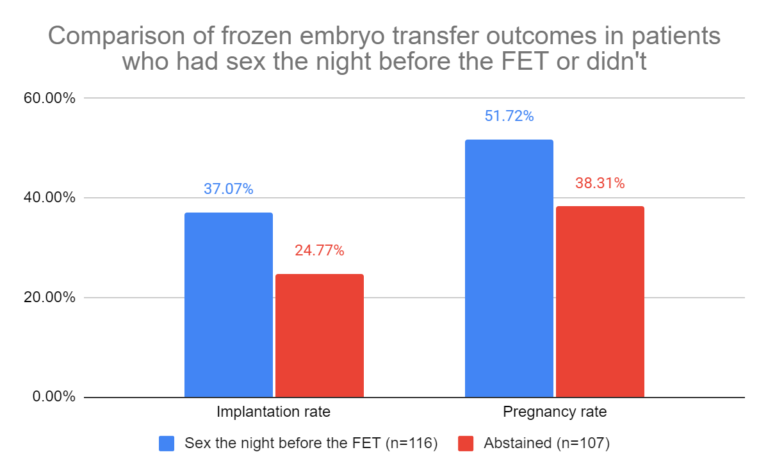
- Higher implantation rates (37.07% vs. 24.77%, p= 0.005)
- Higher clinical pregnancy rates (51.72% vs. 38.31%, p= 0.045)
- Similar miscarriage rates
- Read more: Protected sex the night before frozen embryo transfer linked to improved outcomes.
Aflatoonian et al. (2009) performed a randomized trial examining sexual intercourse after fresh embryo transfer. Couples were randomly assigned to either have intercourse at least once within 12 hours after embryo transfer or abstain throughout the IVF cycle.
- Similar implantation rates (6.5% vs. 5.5%, p = 0.50)
- Similar clinical pregnancy rates (14.2% vs. 11.7%, p = 0.48)
Tremellen et al. (2000) performed a randomized trial examining sexual intercourse around the time of embryo transfer. In 2000, transferring 2-4 embryos was common, so the researchers measured not only pregnancy rates but also how many transferred embryos remained viable after implantation and early in pregnancy. Couples had a fresh or frozen transfer and were randomly assigned to either have sexual intercourse around embryo transfer or abstain.
- Similar pregnancy rates (23.6% vs. 21.2%)
- A higher proportion of viable embryos remained viable at the 6–8 week ultrasound (11.0% vs. 7.7%; OR [95% CI]: 1.48 [1.01–2.19]), suggesting that sexual intercourse may have helped sustain implantation.
Does the timing of sex around embryo transfer matter?
This is a hard question to answer because the existing research looked at sex and embryo transfer at very different times:
- Liu et al. (2026): Intercourse occurred at any time between the end of menstrual bleeding and the day before frozen embryo transfer. No difference in pregnancy or live birth rates.
- Hou et al. (2023): Couples had protected intercourse the night before frozen embryo transfer. Higher implantation and clinical pregnancy rates were observed.
- Aflatoonian et al. (2009): Couples had intercourse within 12 hours after a fresh embryo transfer. No difference in implantation or clinical pregnancy rates.
- Tremellen et al. (2000): Couples had intercourse around the time of embryo transfer (fresh or frozen). Pregnancy rates were similar, although a higher proportion of transferred embryos remained viable at the first ultrasound.
Because these studies looked at different timings, treatment types (fresh vs. frozen), and types of intercourse (protected vs. unprotected), it’s hard to know if timing itself influences implantation or pregnancy rates.
Why might sexual intercourse improve embryo transfer outcomes after IVF?
Researchers have proposed several reasons why sexual intercourse around embryo transfer might improve implantation:
- Increased blood flow to the uterus during sexual arousal, which may improve endometrial receptivity (Hou et al. 2023).
- Changes in reproductive hormones and normal female reproductive tract function triggered by sexual intercourse (Hou et al. 2023).
- Exposure to seminal plasma may help the mother’s immune system tolerate the embryo and support implantation (Crawford et al. 2014).
- Increased formation of new blood vessels in the lining of the uterus (angiogenesis), which may help support implantation (Ata et al. 2018).
One of the leading theories is that seminal plasma (the fluid that carries sperm) contains signaling molecules that interact with the female reproductive tract. These molecules might help the mother’s immune system tolerate the embryo, recruit immune cells to the uterus, improve endometrial receptivity, and support implantation. (Crawford et al. 2015, Ata et al. 2018)
A meta-analysis by Crawford et al. (2015) found that exposure to seminal plasma was associated with higher clinical pregnancy rates (relative risk [95% CI]: 1.23 [1.06-1.42]), but not higher live birth rates. However, a later Cochrane review by Ata et al. (2018) found that seminal plasma might increase clinical pregnancy rates, but the evidence was very low quality and this benefit disappeared when only the highest quality studies were considered. There was no clear improvement in live birth or miscarriage rates.
Because these studies used a variety of approaches, including sexual intercourse and direct application of seminal plasma to the vagina, cervix, or uterus, it’s hard to know if one method is beneficial over another.
Conclusion
Overall, there isn’t enough high quality evidence to conclude that having sex around embryo transfer either improves or harms IVF outcomes. Most studies found no improvement in pregnancy rates, while one randomized trial found higher implantation and clinical pregnancy rates when couples had protected sex the night before frozen embryo transfer.
The studies also looked at intercourse in very different ways, making them difficult to compare. Some measured intercourse over several weeks, while others focused only on the day before or after embryo transfer. Some studies also looked at seminal plasma instead of sexual intercourse itself.
Interestingly, the only randomized trial to find a benefit involved protected sex, meaning seminal plasma wasn’t involved. This suggests that if sexual intercourse does improve IVF outcomes, the reason might be more complex than just exposure to seminal plasma. More research is needed before any firm conclusions can be made.
Until more research is available, it makes sense to follow your clinic’s recommendations, even though it’s still unclear whether sexual intercourse around embryo transfer actually affects implantation or pregnancy rates.
Want to read more about frozen embryo transfers and implantation?
Researchers in a 2023 study found improved frozen embryo transfer outcomes in patients who had protected sex the night before the procedure, that was not attributed to semen contact. Read more.

The post discusses various frozen embryo transfer protocols, which includes a medicated FET, natural cycle FET (true natural/modified natural), and mild ovarian stimulated FET, along with their scheduling. In addition, it examines whether one FET protocol is superior to another, the relevance of the corpus luteum in medicated vs natural cycle FETs, and optimal progesterone levels. Read more.
This post covers the variety of reasons embryos can fail to implant or miscarry, including as a result of advanced maternal age, chromosomal translocations, lifestyle, endometritis, the microbiota, immunological issues, endometrial receptivity, the clinic, and more. Note that this is not a complete list, and will be updated periodically. Read more.

About Embryoman
Embryoman (Sean Lauber) is a former embryologist and the founder of Remembryo, an IVF research and fertility education website. After working in an IVF lab in the US, he returned to Canada and now focuses on making fertility research more accessible. He holds a Master’s in Immunology and launched Remembryo in 2018 to help patients and professionals make sense of IVF research. Sean shares weekly study updates on Facebook, Instagram, and Reddit regularly. He also answers questions on Reddit or in his private Facebook group.