
Researchers in a 2026 study found that more than two-thirds of patients with complete embryo arrest still developed at least one usable blastocyst in their next IVF cycle, although they had lower usable blastocyst formation rates overall and were more likely to experience complete embryo arrest again.
Embryo arrest occurs when an embryo stops developing, typically before reaching the blastocyst stage, meaning it usually cannot be used for transfer or freezing.
Complete embryo developmental arrest generally refers to when none of the fertilized eggs develop into blastocysts. However, IVF labs don’t all use the same criteria for what they consider a usable blastocyst. For example, some clinics don’t biopsy or freeze low quality blastocysts or extend culture to day 7.
In a study by George et al. (2026), researchers examined nearly 4000 patients who had two IVF cycles within one year to see if complete embryo arrest in the first cycle affected blastocyst formation in the next cycle. This study involved PGT-A cycles and only considered usable blastocysts that were able to be biopsied and frozen (those that reached at least grade 4CC by day 7).
For more background, check out my post on Embryo arrest.
Study details
- Study type: Retrospective study performed at a single IVF center in the US between 2017 and 2025.
-
Participants: 3913 patients who had two consecutive IVF cycles with ICSI and PGT-A within one year. All patients had at least two normally fertilized eggs across both cycles. Embryos were cultured to day 7. Blastocysts reaching at least expansion grade 4 with grade C or better were considered suitable for freezing and were biopsied.
- 501 patients had complete embryo developmental arrest (0% blastocyst formation) during their first cycle.
- 3412 patients produced at least one blastocyst in their first cycle.
- After propensity score matching, 444 patients with previous complete embryo arrest were compared with 815 similar patients without embryo arrest. The researchers used propensity score matching to make the groups more similar in terms of age, AMH, BMI, sperm source, stimulation protocol, trigger type, and the number of mature eggs retrieved before comparing outcomes.
- Primary outcome: Usable blastocyst formation rate (the percentage of fertilized eggs that developed into blastocysts 4CC or higher) during the second IVF cycle. Note: The published paper referred to this outcome as the blastocyst formation rate. After publication, the corresponding author confirmed that only usable blastocysts meeting the laboratory’s minimum freezing criteria (≥4CC) were counted. Embryos that developed into blastocysts but didn’t reach this threshold weren’t counted in the blastocyst formation rate. However, because embryos were cultured until day 7 and included CC grades, this approach likely captured the majority of blastocysts.
Previous complete embryo arrest reduced usable blastocyst formation in a second cycle
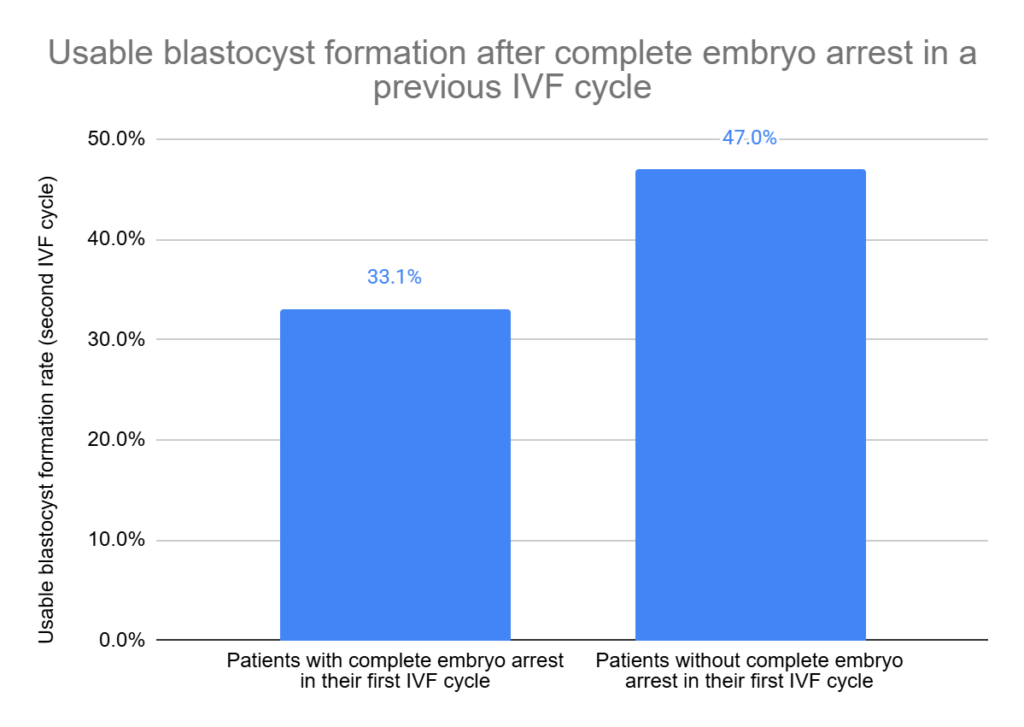
The researchers found that patients who previously had complete embryo arrest had a lower chance of developing usable blastocysts during their second IVF cycle.
-
Usable blastocyst formation rate: Patients with previous complete embryo arrest had a 25% lower chance of developing usable blastocysts (33.1% vs. 47.0%, adjusted relative risk (aRR) [95% CI]: 0.75 [0.70–0.80]).
- Adjusted relative risk (aRR): Relative Risk (also called Risk Ratio, RR) estimates how much more or less likely an outcome is in one group compared with another. The “adjusted” relative risk means the researchers accounted for differences between the groups, such as age, AMH, BMI, and stimulation protocol, helping provide a fairer comparison than the percentages alone.
- What this means: This is a relative, not absolute, decrease. For example, if the usable blastocyst formation rate was 40% in patients without previous complete embryo arrest, a 25% relative decrease would correspond to an absolute usable blastocyst formation rate of 30% in patients with previous complete embryo arrest (from 40% to 30%). You can use the calculator below to see how different baseline rates would change using the adjusted relative risk reported in this study.
Previous embryo arrest influenced other IVF outcomes
- Complete embryo arrest: Patients with previous complete embryo arrest were 82% more likely to have all embryos arrest again (33.6% vs. 17.9%; aRR [95% CI]: 1.82 [1.44–2.30]). Even so, more than two-thirds of patients (66.4%) with previous complete embryo arrest had at least one usable blastocyst in their next IVF cycle.
- Fertilization rate: Patients with previous complete embryo arrest had a 6% lower fertilization rate (76.6% vs. 81.5%; aRR [95% CI]: 0.94 [0.92–0.97]).
- Euploid rate: Among blastocysts that developed, the chance of being chromosomally normal was similar (45.5% vs. 46.7%; aRR [95% CI]: 0.97 [0.81–1.15]).
- Live birth after euploid transfer: Live birth rates after transferring a single euploid embryo were similar (73.6% vs. 74.8%; aRR [95% CI]: 0.98 [0.85–1.12]).
This means that previous complete embryo arrest was associated with a slightly lower fertilization rate and a higher chance of complete embryo arrest happening again. However, if usable blastocysts developed, they were just as likely to be euploid, and live birth rates after transferring a single euploid embryo were similar.
Changing stimulation protocols didn’t improve outcomes
Researchers found no significant difference in usable blastocyst formation or the chance of complete embryo arrest in the next IVF cycle when patients changed their stimulation protocol or trigger medication. The stimulation protocols included antagonist, down-regulation, microflare, and MPA, while the trigger regimens included hCG only, hCG + Lupron, and Lupron only.
Factors associated with lower usable blastocyst formation
Researchers also identified factors associated with lower usable blastocyst formation among patients with a history of complete embryo arrest (using multivariable regression):
- Older female age
- Lower AMH
- BMI above 30 kg/m²
- Down-regulation and microflare stimulation protocols
Conclusion
This study found that patients with complete embryo arrest in their first IVF cycle had lower usable blastocyst formation rates and were more likely to experience complete embryo arrest again in their next cycle. However, more than two-thirds of these patients still developed at least one usable blastocyst. Among the usable blastocysts that formed, the chances of being euploid and leading to a live birth after transferring a single euploid were similar.
These results suggest that complete embryo arrest doesn’t necessarily mean future embryos have poor developmental potential. Instead, it mainly appears to reduce the chance of producing usable blastocysts in the next IVF cycle.
Researchers also found no evidence that changing the ovarian stimulation protocol or trigger medication improved usable blastocyst formation or reduced the chance of complete embryo arrest in the next IVF cycle. More studies are needed to determine the best treatment approach after complete embryo arrest.
Limitations include the retrospective study design, the use of data from a single fertility center, and the possibility that some differences between the groups remained despite propensity score matching. The study only counted usable blastocysts (at least grade 4CC by day 7), so the reported blastocyst formation rates excluded some blastocysts that didn’t meet the laboratory’s biopsy and freezing criteria.
Explore this study with a calculator
🔒 Subscriber resource: Enter different baseline rates to see what this study’s reported adjusted relative risks mean. This tool is for educational purposes and should not be used to predict an individual’s outcome because many other factors can influence the result.
How it works: Choose one of the relative risks reported in the study and enter a baseline rate to see how it changes.
- Example: This study found that patients with previous complete embryo arrest had an adjusted relative risk of 0.75 for usable blastocyst formation compared with patients without previous complete embryo arrest. If the usable blastocyst formation rate is 40% in patients without previous complete embryo arrest, the calculator estimates an average usable blastocyst formation rate of 30% in patients with previous complete embryo arrest.
Statistically significant relative risks reported in this study:
- Usable blastocyst formation (primary outcome): aRR 0.75
- Complete embryo arrest (secondary outcome): aRR 1.82
- Fertilization (secondary outcome): aRR 0.94
The primary outcome is the main result the study was designed to measure. Secondary outcomes provide additional information, but they are often considered more exploratory and should be interpreted with more caution.

Want to read more about embryo arrest?

Embryo arrest is when an embryo stops developing, usually before reaching the blastocyst stage. This post explains possible causes, including embryonic genome activation, maternal effect genes, the subcortical maternal complex, aneuploidy, mitochondrial dysfunction, oxidative stress, lab conditions, and sperm DNA fragmentation. Read more.
Researchers in a 2026 study proposed statistical thresholds that may help distinguish between poor IVF results that can happen by chance and those that may need a closer look. Read more.

A 2025 study introduces the term “oocyte and early embryo competence defects” to describe younger IVF patients who repeatedly have no transferable embryos due to low quality eggs, finding that about 13–23% had genetic changes. Read more.

Researchers in a 2023 study found that arrested embryos have a high degree of aneuploidy, which is mainly due to mitotic errors that occur after fertilization. In a separate analysis of non-arrested embryos, they found that good quality/day 5 embryos have less aneuploidies compared to poor quality/day 6 and 7 embryos. Read more.
Reference

About Embryoman
Embryoman (Sean Lauber) is a former embryologist and the founder of Remembryo, an IVF research and fertility education website. After working in an IVF lab in the US, he returned to Canada and now focuses on making fertility research more accessible. He holds a Master’s in Immunology and launched Remembryo in 2018 to help patients and professionals make sense of IVF research. Sean shares weekly study updates on Facebook, Instagram, and Reddit regularly. He also answers questions on Reddit or in his private Facebook group.