

Researchers in a 2026 meta-analysis combined the results of 7 randomized trials and found that Lactobacillus-containing probiotics were associated with higher clinical pregnancy rates in women having an embryo transfer, although important limitations make the results difficult to interpret.
Trillions of bacteria naturally live throughout the body, including the reproductive tract. Together, these communities of bacteria are called the microbiome. Some researchers think the reproductive tract microbiome may influence fertility by affecting inflammation and how receptive the uterus is to an embryo.
One group of bacteria, Lactobacillus, has received a lot of attention because it is thought to help maintain a healthy vaginal environment. Lactobacillus produces lactic acid and other substances that help limit the growth of potentially harmful bacteria.
Vaginal and oral probiotic supplements containing Lactobacillus are often used to increase Lactobacillus levels, and some studies have suggested they may improve IVF outcomes. However, the results have been mixed.
To better answer this question, Hiratsuka et al. (2026) combined the results of seven randomized trials to see whether Lactobacillus-containing probiotics improve pregnancy rates in women having an embryo transfer.
For more background, see my post The impact of the vaginal and endometrial microbiome on reproductive health and IVF outcomes.
Study details
-
Study design: Systematic review and meta-analysis of 7 randomized controlled trials (RCTs) published between 2023 and 2025:
Jafarabadi et al. (2024), Wei et al. (2024), Tanha et al. (2023), Thanaboonyawat et al. (2023), Lopez et al. (2025), Badihi et al. (2025), and Kamrani et al. (2025). - Risk of bias: Of the 7 randomized trials, the authors judged 6 to have a low risk of bias and 1 as having some concerns. No studies were considered to have a high risk of bias.
- Participants: 796 infertile women undergoing embryo transfer (399 received probiotics, 397 controls). Six studies included vaginal probiotics, and one study included an oral probiotic, over a treatment period spanning 6-180 days.
- Primary outcome: Clinical pregnancy
Probiotic regimens varied across studies
The seven randomized trials used different probiotic formulations, doses, and treatment durations.
- Route: Six studies used vaginal probiotics, while one used an oral probiotic.
- Probiotic strains: Most studies included one or more Lactobacillus species (such as L. rhamnosus, L. plantarum, L. acidophilus, and L. gasseri), although the specific strains and combinations differed between studies.
- Dose: When reported, doses ranged from 1 × 10⁹ to 3 × 10⁹ colony-forming units (CFU) per treatment. Two studies did not report the dose.
- Treatment duration: Three studies treated women for 180 days, one for 30 days, two for 14 days, and one for 6 days.
Because the studies used different probiotic regimens, this meta-analysis cannot determine which is most effective.
Probiotics increased clinical pregnancy rates
Across all 7 randomized trials, women who received a Lactobacillus-containing probiotic had higher clinical pregnancy rates than those who did not.
-
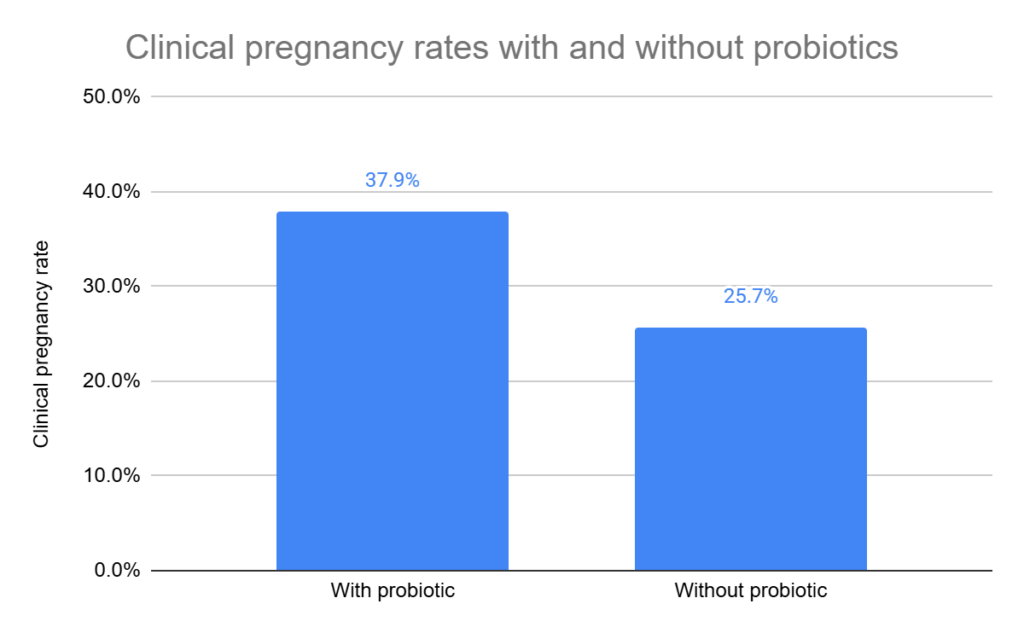
Clinical pregnancy: 37.9% vs 25.7%
- Relative risk (RR) [95% CI]: 1.49 [1.19–1.86] (796 participants, I2= 29%). This means that women who received probiotics had a 49% higher relative chance of achieving a clinical pregnancy. Note that this is a relative, not absolute, increase. For example, a 49% relative increase from a 30% clinical pregnancy rate corresponds to an absolute increase of 14.7 percentage points (from 30% to 44.7%).
- The authors estimated that probiotics resulted in about 12.4 additional clinical pregnancies per 100 women treated.
- Miscarriage: There was no significant difference in miscarriage rates for probiotics vs control (9.8% vs 15.6%, RR 0.78 [0.14-4.49], 3 studies, 433 participants, I2= 28.7%)
Other results
The authors also performed subgroup analyses, where they looked at whether the results differed in certain groups of patients or under different treatment conditions. These analyses can provide useful clues, but they are usually considered less reliable than the main analysis because they are based on smaller groups of patients.
- Treatment duration: Clinical pregnancy rates appeared to improve only in studies where probiotics were given for more than 14 days (RR 1.99 [1.44–2.75]), whereas studies using probiotics for 14 days or less found no clear benefit (RR 1.16 [0.67–2.00]). Because these were also the smallest studies, this finding should be interpreted cautiously.
- Recurrent implantation failure (RIF): Probiotics appeared to improve clinical pregnancy rates only in women without recurrent implantation failure (RR 2.01 [1.40–2.89]), whereas no clear benefit was seen in women with recurrent implantation failure (RR 1.17 [0.80–1.70]).
- Safety: None of the included randomized trials reported adverse events or safety outcomes, so this meta-analysis cannot determine whether probiotic use during IVF is associated with any risks.
Conclusion
This meta-analysis found that Lactobacillus-containing probiotics were associated with higher clinical pregnancy rates in women having an embryo transfer. On average, about 12 more women became pregnant for every 100 women treated. In subgroup analyses, the benefit was seen only in studies where probiotics were given for more than 14 days, and only in non-RIF patients.
One possible explanation is that probiotics help restore a healthier reproductive tract microbiome, which may improve the environment for embryo implantation. However, it isn’t clear that this is how probiotics work.
Although this meta-analysis found a statistically significant increase in clinical pregnancy rates, the results should be interpreted with caution. Meta-analyses are often considered the highest level of evidence because they combine results from multiple studies, but their conclusions depend on the studies they include. This meta-analysis included seven randomized trials, but five enrolled fewer than 100 participants. The two largest trials (163 and 316 participants for Thanaboonyawat et al. 2023 and Jafarabadi et al. 2024) found no benefit.
The studies also included different types of patients, used different probiotic strains, doses, and treatment lengths, and some combined probiotics with other treatments, making it difficult to isolate the effect of the probiotics. Most studies reported clinical pregnancy, but one reported live birth instead. Because clinical pregnancy and live birth are different outcomes, this makes the overall results of the meta-analysis harder to interpret.
These results should also be considered alongside an earlier meta-analysis by Maleki-Hajiagha et al. (2025), which included many of the same randomized trials but found no significant improvement in clinical pregnancy rates.
Importantly, this meta-analysis looked at clinical pregnancy rates rather than live birth rates, so it’s still unclear whether probiotics improve the chance of taking home a baby.
Overall, Lactobacillus-containing probiotics may improve clinical pregnancy rates, but the current evidence makes it difficult to know how much they help, which patients are most likely to benefit, or whether they increase live birth rates.
Explore this study with a calculator
🔒 Subscriber resource: Enter different baseline rates to see what this study’s reported relative risks mean. This tool is for educational purposes and should not be used to predict an individual’s outcome because many other factors can influence the result.
How it works: Choose one of the relative risks reported in the study and enter the matching baseline rate.
- Example: This study found that probiotics were associated with a relative risk of 1.49 for clinical pregnancy. If the baseline clinical pregnancy rate is 30%, the calculator estimates an average clinical pregnancy rate of 44.7% with probiotics.
Relative risks reported in this study:
- Clinical pregnancy (primary outcome): RR 1.49
- Miscarriage (secondary outcome): RR 0.78
The primary outcome is the main result the study was designed to measure. Secondary outcomes provide additional information, but they are often considered more exploratory and should be interpreted with more caution.

Want to read more about probiotics and IVF?
This post reviews what research currently shows about the vaginal and endometrial microbiome and how it may relate to fertility and IVF outcomes. While Lactobacillus species are often considered beneficial and are commonly found in the reproductive tract, studies examining whether microbiome differences actually affect IVF success have produced mixed results. Read more.

Researchers in a 2023 study found that probiotic supplementation had no impact on positive hCG pregnancy rates, but may improve miscarriage rates. Read more.
Researchers in a 2023 study compared fertility outcomes in women trying to conceive who took myo-inositol, probiotic and micronutrient supplements and found no improvements in clinical pregnancy and live birth rates, with contrasting outcomes in time-to-conception based on BMI. Read more.
Reference

About Embryoman
Embryoman (Sean Lauber) is a former embryologist and the founder of Remembryo, an IVF research and fertility education website. After working in an IVF lab in the US, he returned to Canada and now focuses on making fertility research more accessible. He holds a Master’s in Immunology and launched Remembryo in 2018 to help patients and professionals make sense of IVF research. Sean shares weekly study updates on Facebook, Instagram, and Reddit regularly. He also answers questions on Reddit or in his private Facebook group.