

Researchers in a 2021 study analyzed nearly 100,000 FETs from the US SART registry and found that blastocyst stage transfers were slightly more likely to result in male live births than cleavage stage transfers.
We’ve seen plenty of data that compares the IVF outcomes of cleavage stage and blastocyst stage transfers. Overall, blastocysts tend to perform better compared to cleavage stage.
During the first few days after fertilization, the embryo relies largely on molecules stored in the egg. Around Day 3, the embryo begins activating its own genome. From that point on, development depends more on the embryo’s own genetics and metabolism.
Besides pregnancy outcomes, another interesting question is if the stage of the embryo influences the baby’s sex. Does a cleavage stage or blastocyst stage embryo have a higher chance of producing a male baby?
For more background on embryo development, check out my Complete guide to embryo quality and success rates.
🔗 Original studies are referenced in this post or within the linked Remembryo posts.
💡 Reminder: Terms underlined with a dotted black line have glossary definitions. Hover or tap to see a short definition, or select “Read full definition” in the pop-up to view the complete glossary entry. Viewing glossary entries does not count toward your paywall limit.
There’s evidence that the male-to-female sex ratio is slightly skewed towards male in IVF, and that this might have to do with male embryos growing faster compared to female embryos, although why this happens isn’t clear.
So what’s the biological difference between male and female embryos? Most cells in the body contain 46 chromosomes. Male embryos typically have one X chromosome and one Y chromosome (XY), while female embryos have two X chromosomes (XX).
Researchers have proposed several explanations for why male embryos may develop slightly faster. One idea is that female embryos must inactivate one of their two X chromosomes early in development, which could slightly delay development. Another is that genes on the Y chromosome may promote faster early growth. Because clinics generally transfer the most advanced-looking embryo, male embryos may be selected slightly more often if they reach the blastocyst stage sooner. This could help explain why blastocyst transfers result in slightly more male births. However, the exact biological mechanism is still unclear.
Existing research that examines this has mainly been in the context of fresh transfers, and Perlman et al. (2021) wanted to see if this applied to frozen embryo transfers (FETs) on a larger scale
They analyzed SART registry data collected between 2004 and 2013, including over 55,000 blastocyst stage transfers and 42,000 cleavage stage transfers.
Male live births accounted for 50.5% of births after cleavage stage transfer and 51.9% after blastocyst stage transfer (p< 0.001). This difference corresponds to about 1.4 additional male births per 100 live births following blastocyst transfer.
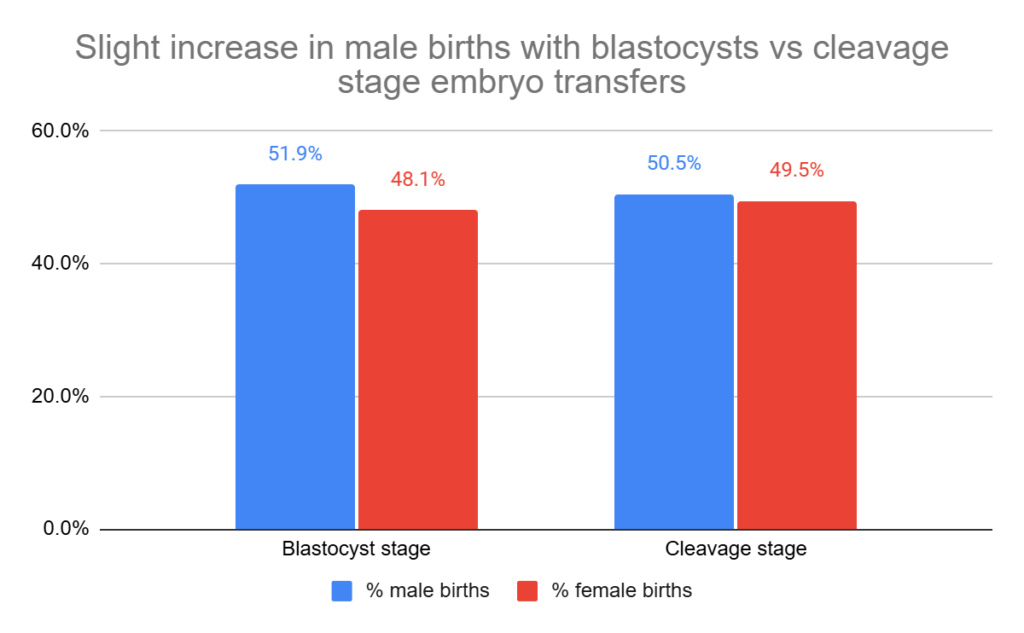
This was statistically significant even after statistical adjustment for maternal age, BMI, race, and male factor infertility.
While the difference is statistically significant, it’s not really meaningful for individual patients. Even after blastocyst transfer, the chance of having a boy or girl is still close to 50:50.
Other studies have shown a skewed male live birth rate with blastocysts:
- Bu et al. (2014): 54.9% vs 51.4%.
- Dean et al. (2010): 54.1% vs 49.9%.
- Luke et al. (2008): 51.6% vs 48.9%.
- Supramaniam et al. (2019): 104.8 vs 101.2 male births per 100 female births.
Updated July 2026: A meta-analysis by Siristatidis et al. (2022) reached a similar conclusion, finding a slightly higher probability of male births following blastocyst transfer compared with cleavage-stage transfer.
Researchers aren’t sure why this happens. One possibility is that male embryos develop slightly faster than female embryos, making them more likely to reach the blastocyst stage first. Because clinics generally transfer the most advanced-looking embryo, this could slightly increase the chance of transferring a male embryo. However, the exact reason isn’t clear.
Want to read more about embryo development and sex selection?

Not sure what your embryo grade means—or if it affects your chances of success? This guide walks you through everything from day 3 and day 5 grading systems to what each number and letter combo (like 3BB or 5AA) actually means. You'll also find success rate research, embryo photos, and insights from a former embryologist to help make sense of your report. Read more.

Researchers in their 2022 Cochrane review, performed a meta-analysis and combined the results of 32 studies that compared pregnancy outcomes of blastocyst and cleavage stage embryos, and found that blastocysts tend to produce better outcomes. Read more.

Researchers in a 2023 study found that good quality embryos were more likely to give rise to male births, particularly those with higher quality trophectoderm scores. Read more.

Researchers in a 2023 study developed a new sperm selection technique that was able to enrich sperm to produce more embryos of a particular sex, with normal IVF and neonatal outcomes. Read more.
Reference

About Embryoman
Embryoman (Sean Lauber) is a former embryologist and the founder of Remembryo, an IVF research and fertility education website. After working in an IVF lab in the US, he returned to Canada and now focuses on making fertility research more accessible. He holds a Master’s in Immunology and launched Remembryo in 2018 to help patients and professionals make sense of IVF research. Sean shares weekly study updates on Facebook, Instagram, and Reddit regularly. He also answers questions on Reddit or in his private Facebook group.