

In a 2026 meta-analysis, researchers combined the results of 17 studies and found that day 7 blastocysts had lower live birth rates than day 5 or day 6 blastocysts, even when only euploid embryos were compared, but they still had meaningful potential for success.
Day 7 blastocysts develop more slowly, and not all IVF labs routinely culture embryos to day 7.
Extending culture to day 7 may allow some additional embryos to reach the blastocyst stage, but it’s not clear how likely they are to result in pregnancy or live birth compared with faster-growing day 5 or day 6 blastocysts.
Firmin et al. (2026) performed a meta-analysis that combined the results of 17 studies comparing outcomes after frozen transfers of day 7 blastocysts with day 5 and/or day 6 blastocysts. The researchers also separately analyzed PGT-A euploid blastocysts to see if there were still differences.
For more background, see my Comprehensive Guide to Embryo Grading and Success Rates.
🔗 Original studies are referenced in this post or within the linked Remembryo posts.
💡 Reminder: Terms underlined with a dotted black line have glossary definitions. Hover or tap to see a short definition, or select “Read full definition” in the pop-up to view the complete glossary entry. Viewing glossary entries does not count toward your paywall limit.
Study details
- Study design: Systematic review and meta-analysis of 17 retrospective studies published between 2006 and 2024.
- Participants: The review included 2,908 day 7 frozen blastocyst transfers from studies comparing day 7 with day 5 and/or day 6 blastocysts and reporting clinical pregnancy or live birth. Some studies included PGT-A, allowing separate analysis of euploid blastocysts, while case reports and studies with fewer than 15 day 7 transfers were excluded.
- Risk of bias: 1 study was rated as low risk of bias, 13 as moderate risk, and 3 as serious risk.
- Quality of evidence: The evidence for clinical pregnancy and live birth when comparing day 7 with day 5 blastocysts was rated as moderate certainty.
All percentages in this post were calculated from the event rates reported in the study’s forest plots.
Untested day 7 blastocysts had lower live birth rates
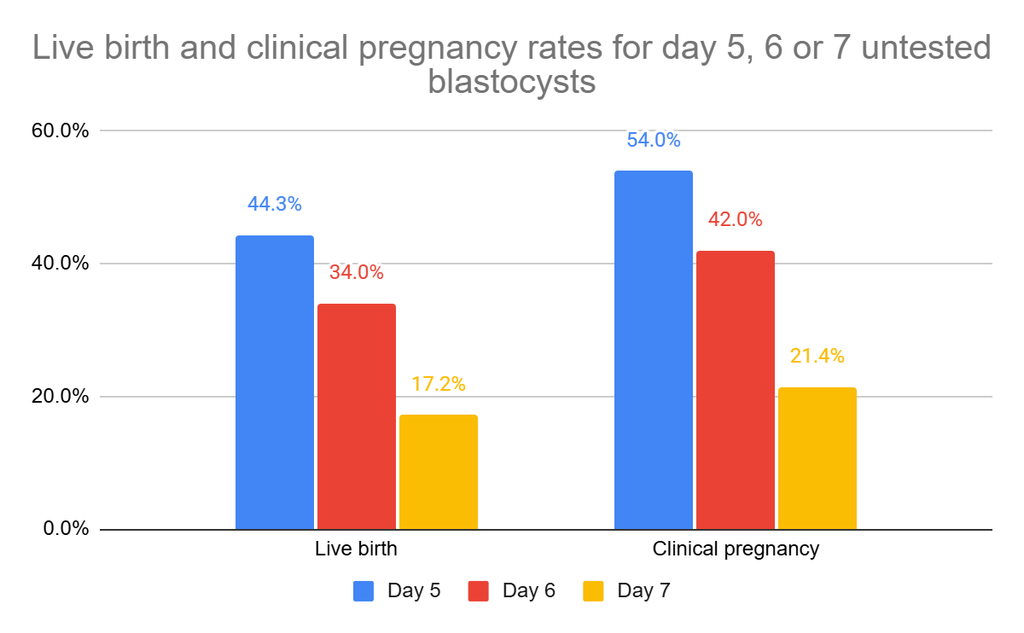
The researchers separately analyzed blastocysts with or without PGT-A. For embryos without PGT-A, day 7 blastocysts had lower live birth and clinical pregnancy rates than both day 5 and day 6 blastocysts.
Day 7 vs day 5
-
Live birth: 17.3% vs 44.3%
- Day 7 blastocysts had 75% lower odds of live birth than day 5 blastocysts (odds ratio [95% CI]: 0.25 [0.13–0.49], 7 studies, 25,706 day 5 and 2323 day 7 transfers, I2= 86%).
- An odds ratio is not the same as the difference between the percentages reported above. For example, if the live birth rate were 40.0% with a day 5 blastocyst, an odds ratio of 0.25 corresponds to an estimated live birth rate of about 14.3% with a day 7 blastocyst. The percentages show the overall rates, while the odds ratio provides a better comparison between the groups. See the Odds Ratio (OR) glossary term to learn more, or use the calculator at the end of this post to explore what the odds ratios reported in this study mean at different starting rates.
- Clinical pregnancy: Lower for day 7 than day 5 blastocysts (21.4% vs 54.0%, OR 0.28 [0.17–0.48], 9 studies, 26,062 day 5 and 2380 day 7 transfers, I2= 84.9%).
- Miscarriage: Higher for day 7 than day 5 blastocysts (17.9% vs 16.9%, OR 1.47 [1.02–2.12], 8 studies, 14,062 day 5 and 503 day 7 pregnancies, I2= 26.1%).
Day 7 vs day 6
- Live birth: Lower for day 7 than day 6 blastocysts (17.2% vs 34.0%, OR 0.39 [0.22–0.67], 7 studies, 22,905 day 6 and 2323 day 7 transfers, I2= 76%).
- Clinical pregnancy: Lower for day 7 than day 6 blastocysts (21.4% vs 42.0%, OR 0.41 [0.29–0.60], 9 studies, 23,049 day 6 and 2380 day 7 transfers, I2= 68.9%).
- Miscarriage: No difference between day 7 and day 6 blastocysts (OR 1.24 [0.85–1.80], 8 studies, 9603 day 6 and 503 day 7 pregnancies, I2= 29.9%).
Euploid day 7 blastocysts also had lower live birth rates
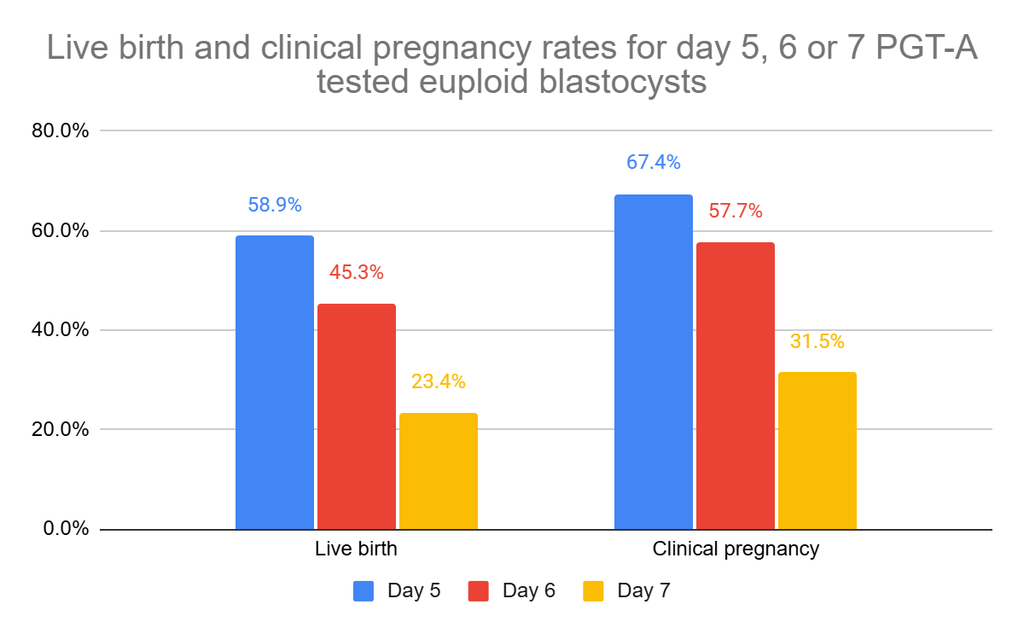
The researchers then looked only at euploid blastocysts after PGT-A. Even with euploid blastocysts, day 7 blastocysts had lower live birth and clinical pregnancy rates.
Day 7 vs day 5
-
Live birth: 23.4% vs 58.9%
- Euploid day 7 blastocysts had 79% lower odds of live birth than euploid day 5 blastocysts (OR 0.21 [0.17–0.28], 6 studies, 5924 day 5 and 364 day 7 transfers, I2= 0%).
- Clinical pregnancy: Lower for euploid day 7 than day 5 blastocysts (31.5% vs 67.4%, OR 0.21 [0.14–0.33], 7 studies, 7064 day 5 and 365 day 7 transfers, I2= 58%).
- Miscarriage: Higher for euploid day 7 than day 5 blastocysts (20% vs 11.8%, OR 2.78 [1.57–4.89], 6 studies, 4018 day 5 and 95 day 7 pregnancies, I2= 32.4%).
Day 7 vs day 6
- Live birth: Lower for euploid day 7 than day 6 blastocysts (23.6% vs 45.3%, OR 0.36 [0.28–0.46], 6 studies, 3782 day 6 and 364 day 7 transfers, I2= 0%).
- Clinical pregnancy: Lower for euploid day 7 than day 6 blastocysts (31.5% vs 57.7%, OR 0.36 [0.28–0.46], 7 studies, 4617 day 6 and 365 day 7 transfers, I2= 40.8%).
- Miscarriage: No difference between euploid day 7 and day 6 blastocysts (OR 2.42 [0.94–6.28], 6 studies, 1988 day 6 and 95 day 7 pregnancies, I2= 46.3%).
Day 7 blastocysts were less likely to be euploid
The researchers also compared the chance that blastocysts reaching the blastocyst stage on different days were euploid. Day 7 blastocysts were less likely to be euploid compared with both day 5 (OR 0.46 [0.39–0.54]) and day 6 blastocysts (OR 0.64 [0.60–0.68]).
Maternal age is a key factor affecting embryo euploidy rates, but these results show that the day an embryo reaches the blastocyst stage is also associated with euploidy.
Perinatal and birth outcomes were similar, but data were limited
There were no significant differences between day 7 and day 5 or day 6 blastocysts for preterm birth, low birthweight (<2,500 g), or birth defects. One study also found no increased risk of neonatal mortality with day 7 blastocysts.
However, only a few studies reported perinatal outcomes, so there isn’t enough evidence to draw firm conclusions.
Conclusion
This meta-analysis found that day 7 blastocysts had lower clinical pregnancy and live birth rates than day 5 or day 6 blastocysts. Day 7 blastocysts were also less likely to be euploid.
Importantly, there were still differences in pregnancy and live birth rates even after only euploid blastocysts were considered. This suggests that the lower success rates with day 7 blastocysts can’t be explained by euploid status alone.
Miscarriage was also higher for day 7 than day 5 blastocysts, including when only euploid blastocysts were compared. However, there was no significant difference in miscarriage between day 7 and day 6 blastocysts.
This research shows that day 7 blastocysts have potential, and the authors highlight their value for patients with few or no other embryos available, writing that they deserve consideration “rather than being dismissed outright.”
Why do day 7 embryos have lower potential? The authors suggest that slower development may reflect other differences within the embryo, such as metabolic or molecular differences, that affect its ability to implant and develop.
Other factors may also help explain differences in success rates. Most studies didn’t account for blastocyst quality, and lower-quality day 7 blastocysts may have lower success rates than higher-quality ones. There were also differences in how clinics defined and timed day 7, so the authors recommended reporting the exact number of hours after insemination to make results easier to compare across studies.
Other limitations include that all studies were retrospective, most had a moderate risk of bias, most analyses didn’t account for blastocyst quality, expansion stage, or maternal age, there were differences between studies in laboratory and transfer protocols, relatively few day 7 blastocysts were included compared with day 5 and day 6 blastocysts, and data on perinatal and long-term child health outcomes were limited.
Explore this study with a calculator
🔒 Subscriber resource: Enter different baseline rates to see what this study’s reported odds ratios mean. This tool is for educational purposes and should not be used to predict an individual’s outcome because many other factors can influence the result.
How it works: Choose one of the odds ratios reported in the study and enter a baseline rate to see the estimated rate for day 7 blastocysts.
- Example: For untested blastocysts, day 7 had lower odds of live birth than day 5 (OR 0.25). If the starting live birth rate for day 5 blastocysts is 40.0%, this corresponds to an estimated live birth rate of about 14.3% for day 7 blastocysts.
Odds ratios reported in this study:
-
Untested blastocysts
- Live birth, day 7 vs day 5: OR 0.25
- Live birth, day 7 vs day 6: OR 0.39
- Clinical pregnancy, day 7 vs day 5: OR 0.28
- Clinical pregnancy, day 7 vs day 6: OR 0.41
-
PGT-A euploid blastocysts
- Live birth, day 7 vs day 5: OR 0.21
- Live birth, day 7 vs day 6: OR 0.36
- Clinical pregnancy, day 7 vs day 5: OR 0.21
- Clinical pregnancy, day 7 vs day 6: OR 0.36
The calculator illustrates the average associations reported in this meta-analysis. It doesn’t predict the chance of success for an individual embryo or patient.

Want to read more about embryo development timing and success rates?

In a 2025 meta-analysis, day 5 blastocysts were linked to higher pregnancy and live birth rates than day 6 blastocysts, while newborn outcomes were similar and poor quality day 5 embryos showed comparable potential to good quality day 6 embryos. Read more.
A new study showed that day 7 embryos may develop more slowly because of stress and disrupted signaling in the inner cell mass, which might help explain their lower success rates. Read more.

Researchers in a 2023 study found that day 7 euploids have the lowest ongoing pregnancy rate, when compared to day 5 and 6 euploids. These embryos were mostly poor quality. Read more.

Not sure what your embryo grade means—or if it affects your chances of success? This guide walks you through everything from day 3 and day 5 grading systems to what each number and letter combo (like 3BB or 5AA) actually means. You'll also find success rate research, embryo photos, and insights from a former embryologist to help make sense of your report. Read more.
Reference

About Embryoman
Embryoman (Sean Lauber) is a former embryologist and the founder of Remembryo, an IVF research and fertility education website. After working in an IVF lab in the US, he returned to Canada and now focuses on making fertility research more accessible. He holds a Master’s in Immunology and launched Remembryo in 2018 to help patients and professionals make sense of IVF research. Sean shares weekly study updates on Facebook, Instagram, and Reddit regularly. He also answers questions on Reddit or in his private Facebook group.